
Park Güell in Barcelona
One of the most characteristic areas of Barcelona is the famous Park Güell, designed by Catalan architect Antoni Gaudí.
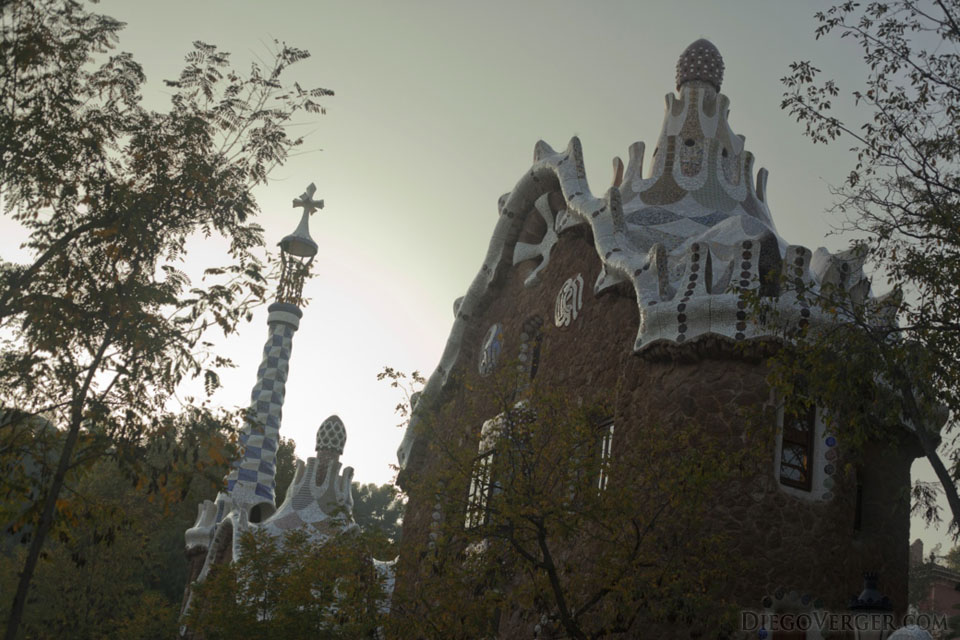
Park Güell Entrance
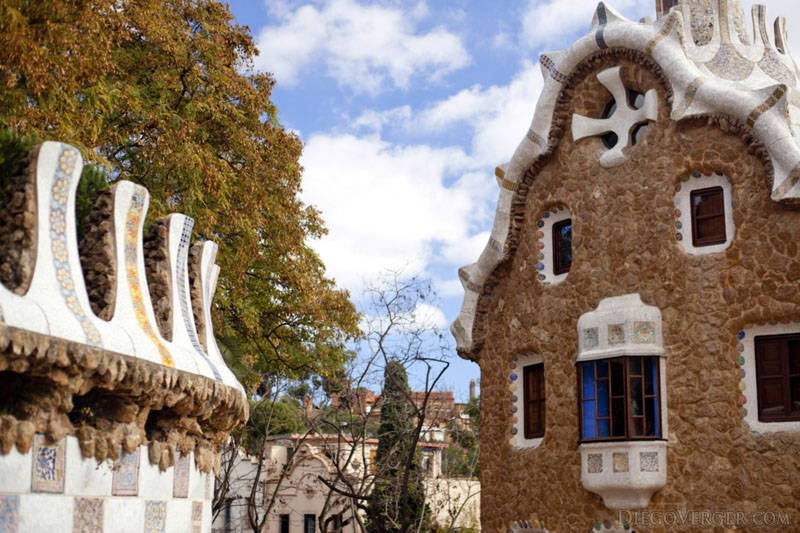
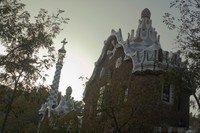 In a mixture of fantasy and originality, the architectural and ornamental structures designed by Gaudí merge with the nature of the Park. This work was commissioned to Gaudí by count Eusebi Güell, and construction began in 1900, although the initial plan was not to create a park but a residential complex. In this photo you can see the pavilions at the main entrance of the park.
Main entrance pavilion
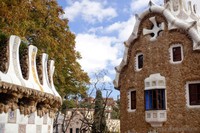 The buildings at the entrance of the park are amongst the few built out of the 60 that had been planned in the original project, with the distinctive Gaudí style. Other houses in the park include the Gaudí House Museum, shown later on, and a residence that was used by count Güell for some time, which is currently a school.
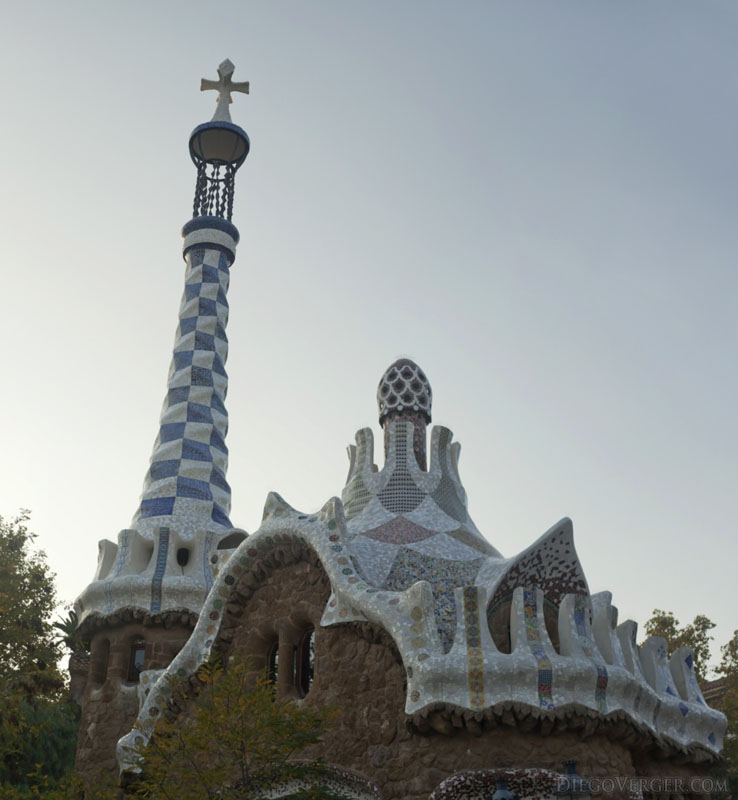
Park Güell administration pavilion
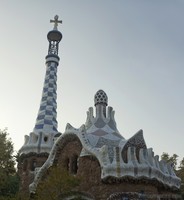 The administration pavilion crowned by a pine cone ornament, and the four-armed cross on top of its tower, is mainly used as a bookshop and a souvenirs shop.
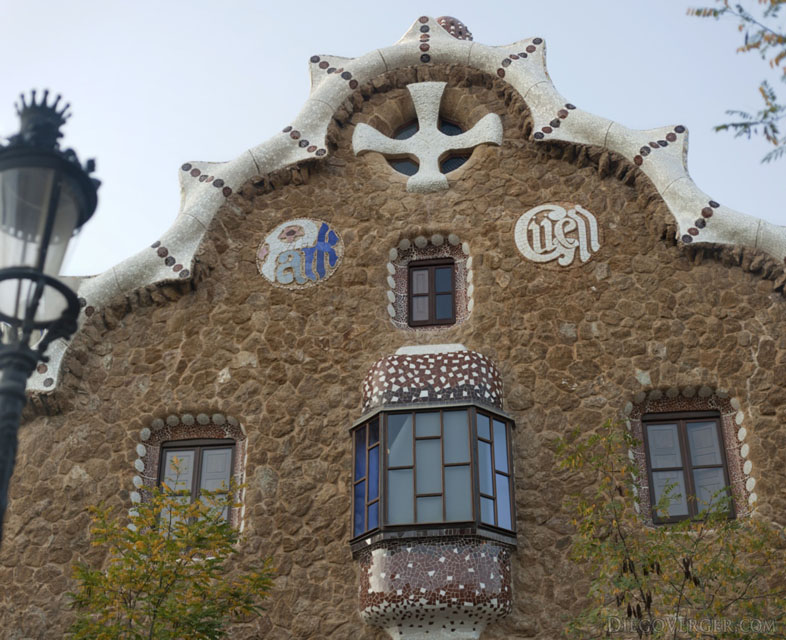
Casa del Guarda of Park Güell
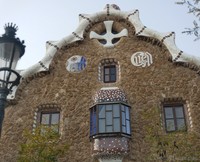 This is the “Casa del Guarda” (porter’s lodge), a pavilion built at the gates of Park Güell, which was intended to be the house of the custodian in the original plans for a residential complex. It is currently used as a permanent exhibition of photos and films about the history of Park Güell, and is part of the Barcelona History Museum. At the top you can see a cross pattée (?), sometimes associated with the Knights Templar, and other orders, an interesting solution for a round window. Count Güell was interested in the style of the British parks of the time, so he named the park in English, “Park Güell”, as you can see in the mosaics below the cross pattée.
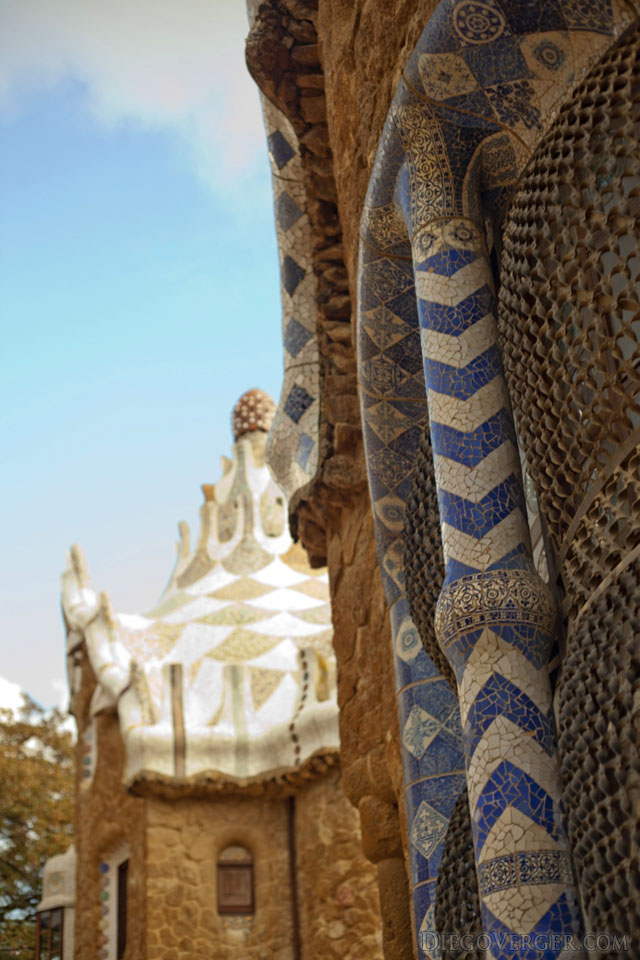
Detail of the mosaic work in a pavilion
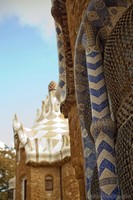 Both from near and afar, you can see the level of detail in Gaudí’s designs, as in these mosaics in a curved frame of the administration pavilion.
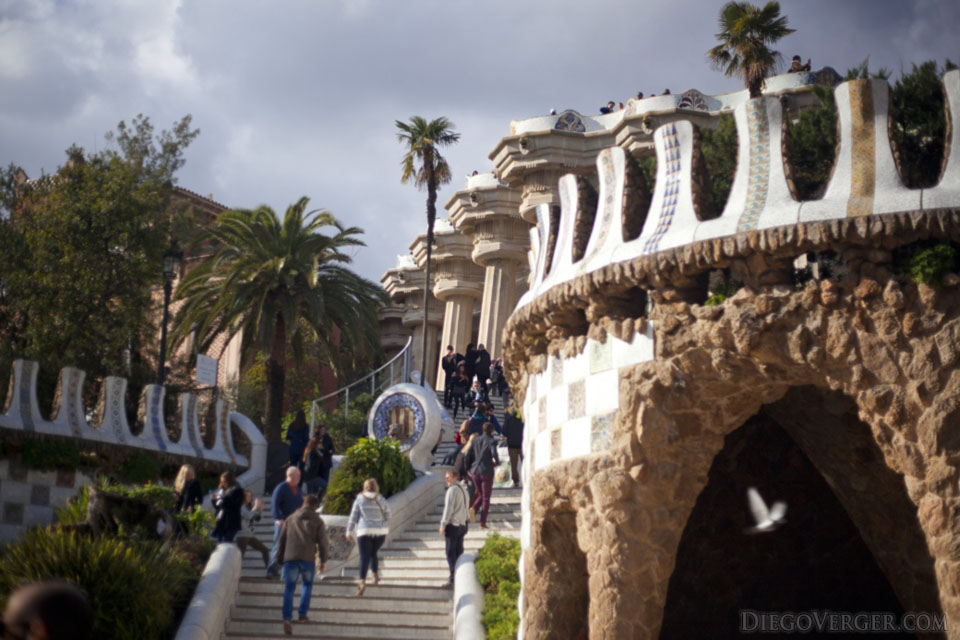
Monumental Zone of Park Güell
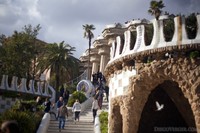 The highest platform on the right, with gargoyles, corresponds to the Greek Theater, which consists of a large plaza for events, and also serves as a great viewpoint of Barcelona. On the left, the main stairs of the park, which are decorated with a quite impressive mosaic work, where every motif is unique.
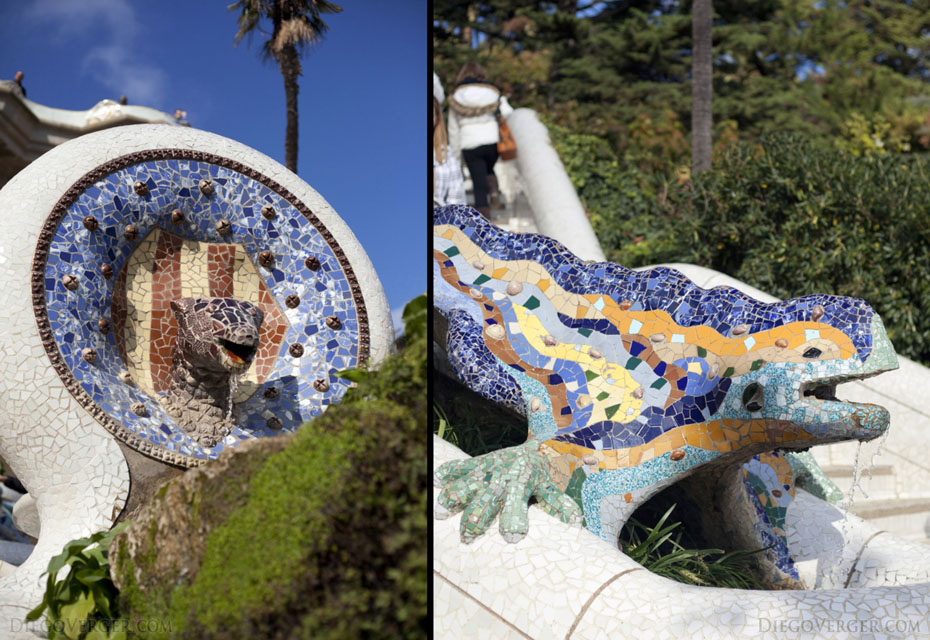
Snake and Dragon
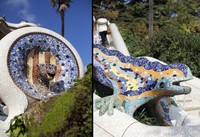 On the left, the Catalan coat of arms with a snake. On the right, the dragon or salamander decorated with mosaics (trencadis style) in the main stairs of Park Güell.
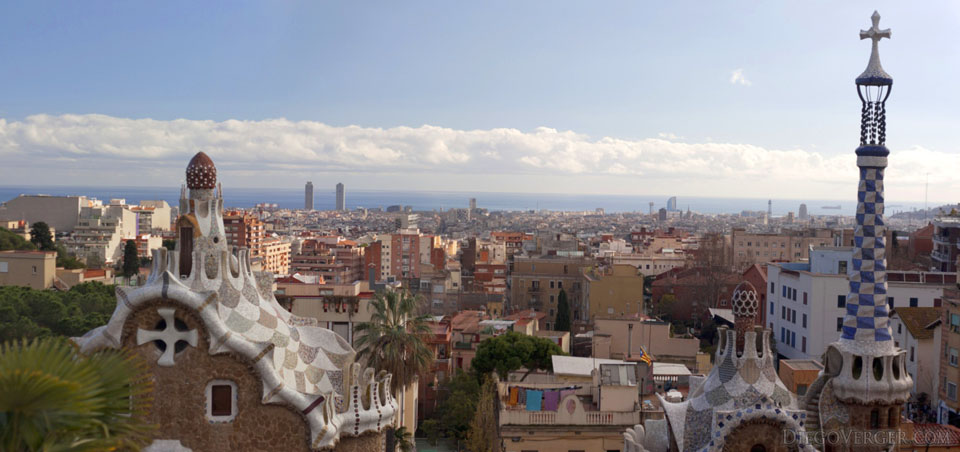
Panoramic view of Barcelona
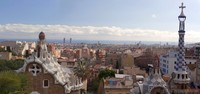 View of the city of Barcelona and the Mediterranean from the plaza of the Greek Theater, also known as Nature Square. In the foreground you can see the “Casa del Guarda” or porter’s lodge, by the entrance of the park.
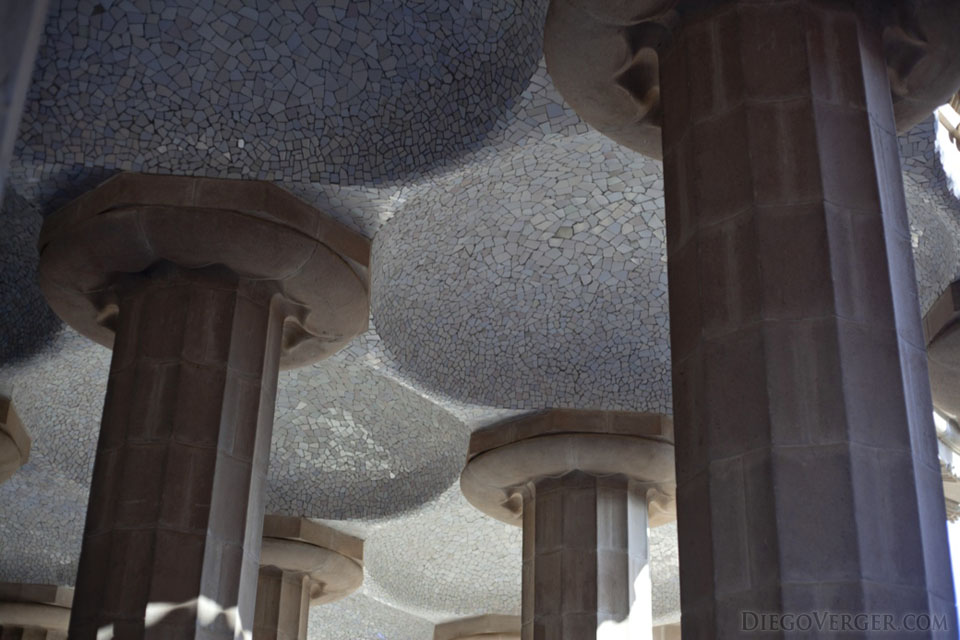
Doric columns of the Hypostyle Room
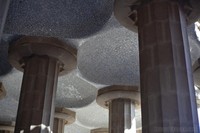 These huge Doric columns are highly resistant, but are also hollow, since Gaudí designed them to fulfil a dual function. They serve as a support for the Greek Theater square above, and are also part of a drainage system of the square, which ends in a cistern excavated in the rock deep below.
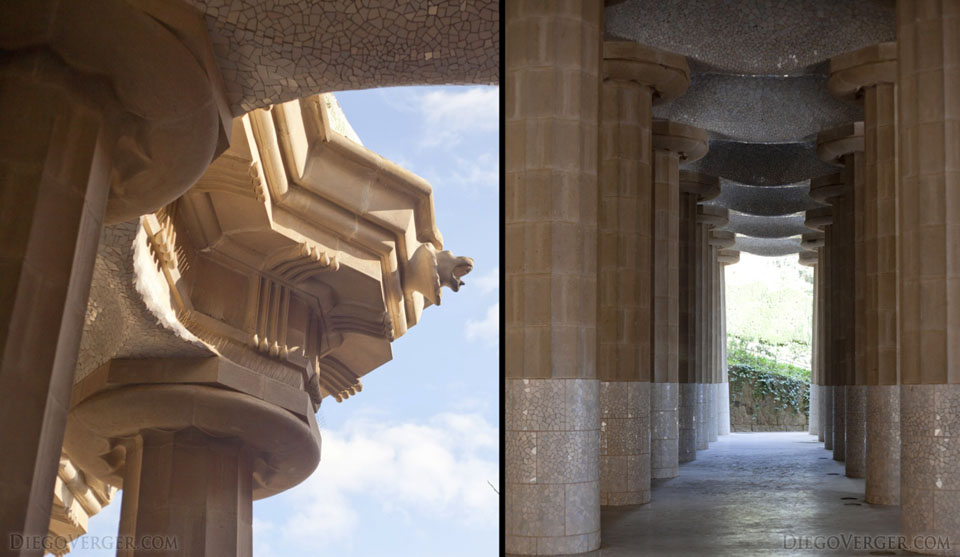
Gargoyle and Hypostyle Room
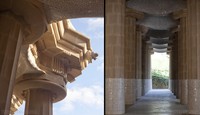 On the left, one of the gargoyles that surround the Greek Theatre square, above the Hypostyle Room. On the right, the Hypostyle Room.
Viaducts of Park Güell
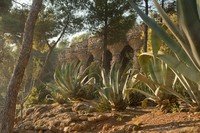 Walking along Park Güell’s paths you stumble upon views like this one in which the structures designed by Gaudí adapt to the environment simulating natural formations, at the same time that they play a practical role, as this viaduct that serves as a covered pedestrian path below, and a road apt for vehicles above, in a mix of practicality and art immersed in nature.
Viaducts
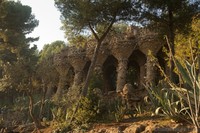 Another exterior view of one of the viaducts of the park. The upper part was originally intended for carriages.
Gallery of a viaduct
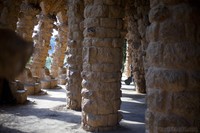 These galleries connect different sectors of the park, and serve as support for the platforms above, originally intended for vehicular traffic, although they are mainly used by the visitors of the park now. It is common to find musicians playing guitar in these galleries, who choose these structures for their acoustic effect, and their stone seats at the foot of the columns.
Ceiling of a gallery
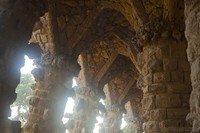 This is an inside view of the viaduct of the previous photo. The support columns create a truly artistic gallery.
Detail of a viaduct’s ceiling
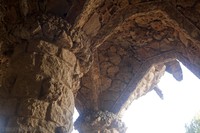 Another view of the ceiling of one of these galleries that are part of the trails in Park Güell, with arches that look like a reflection of a Gothic past.
The Laundry Room Portico
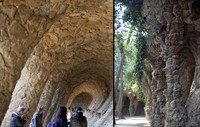 A portico with inclined columns that adapt to a retaining wall.
Gaudí House Museum
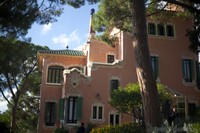 This House was built as a sample property for the original project of a residential complex. Upon cancellation of the former project, it was acquired and used as a residence by Gaudí from 1906 to 1925. Now it is a museum.
The flower tunnel
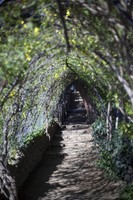 This tunnel is located in the garden of the Gaudí House Museum, and makes up a natural frame, ideal for photographic portraits.
Cosmos
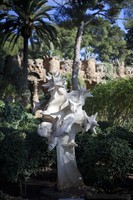 Sculpture entitled Cosmos, a copy of a sculpture of the Basilica of the Sagrada Familia from 1900.
Viaduct interior
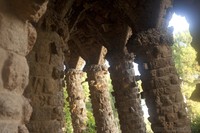 Interior view of the gallery of one of the three viaducts in Park Güell.
The four-armed cross
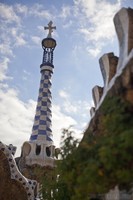 The cross of the administration pavilion. The four-armed cross is very characteristic in Gaudí’s works, or its bidimensional version, the cross pattée, as the one shown in the “Casa del Guarda” next to this building.
Park Güell trails
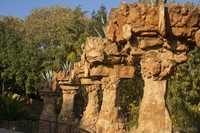 Walking in park Güell is like walking along the paths of an open-air museum, where it is usually necessary to stop and contemplate in order to differentiate where nature ends and the work of Gaudí begins, as in the case of these stone column-pots with plants on top.
The Greek Theatre square
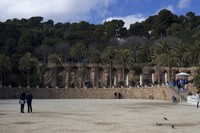 This plaza is also known as Nature Square. It is sometimes used for large events.

Media (23)
 Park Güell Entrance
 Main entrance pavilion
 Administration pavilion
 Casa del Guarda of Park Güell
 Detail of the mosaic work in a pavilion
 Monumental Zone of Park Güell
 Snake and Dragon
 Panoramic view of Barcelona
 Doric columns of the Hypostyle Room
 Gargoyle and Hypostyle Room
Viaducts of Park Güell - Park Güell in Barcelona
Viaducts of Park Güell
Viaducts - Park Güell in Barcelona
Viaducts
Gallery of a viaduct - Park Güell in Barcelona
Gallery of a viaduct
Ceiling of a gallery - Park Güell in Barcelona
Ceiling of a gallery
Detail of a viaduct’s ceiling - Park Güell in Barcelona
Detail of a viaduct’s ceiling
The Laundry Room Portico - Park Güell in Barcelona
The Laundry Room Portico
Gaudí House Museum - Park Güell in Barcelona
Gaudí House Museum
The flower tunnel - Park Güell in Barcelona
The flower tunnel
Cosmos - Park Güell in Barcelona
Cosmos
Viaduct interior - Park Güell in Barcelona
Viaduct interior
The four-armed cross - Park Güell in Barcelona
The four-armed cross
Park Güell trails - Park Güell in Barcelona
Park Güell trails
The Greek Theatre square - Park Güell in Barcelona
The Greek Theatre square
Gargoyle and Hypostyle Room
Viaducts of Park Güell - Park Güell in Barcelona
Viaducts of Park Güell
Viaducts - Park Güell in Barcelona
Viaducts
Gallery of a viaduct - Park Güell in Barcelona
Gallery of a viaduct
Ceiling of a gallery - Park Güell in Barcelona
Ceiling of a gallery
Detail of a viaduct’s ceiling - Park Güell in Barcelona
Detail of a viaduct’s ceiling
The Laundry Room Portico - Park Güell in Barcelona
The Laundry Room Portico
Gaudí House Museum - Park Güell in Barcelona
Gaudí House Museum
The flower tunnel - Park Güell in Barcelona
The flower tunnel
Cosmos - Park Güell in Barcelona
Cosmos
Viaduct interior - Park Güell in Barcelona
Viaduct interior
The four-armed cross - Park Güell in Barcelona
The four-armed cross
Park Güell trails - Park Güell in Barcelona
Park Güell trails
The Greek Theatre square - Park Güell in Barcelona
The Greek Theatre square